Artificial Scarcity & The Baha’i Faith

The Problem . ARTIFICIAL SCARCITY is a term used to describe the condition in which masses of people are deprived of their bare necessities, while wealth, resources, and infrastructure exist in sufficient proportion to provide for all. The amount of … Continue reading Artificial Scarcity & The Baha’i Faith

Releasing the Deep Reservoirs that Young People Possess

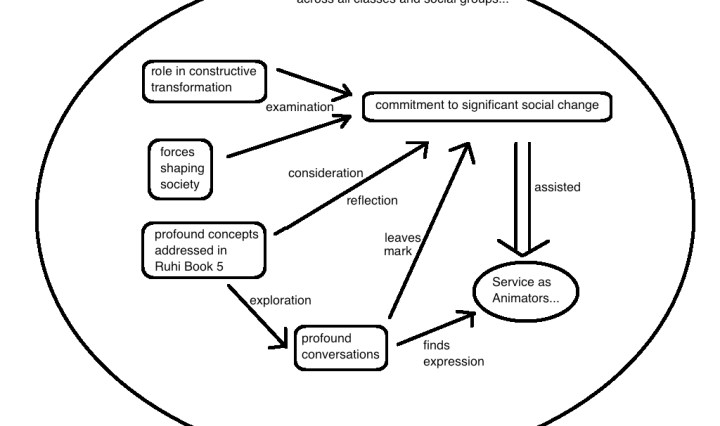
“Throughout the world, across all classes and social groups, there has been a ready response from youth who are invited to examine the forces shaping their society and their role in contributing to its constructive transformation through service as animators … Continue reading Releasing the Deep Reservoirs that Young People Possess

The Structure of Future Scientific Revolutions

Science is in its infancy. It will evolve, change, and grow until it achieves a more mature form. To date, the human experience suffers from an underdeveloped understanding of the nature and scope of the scientific enterprise. Those who suffer … Continue reading The Structure of Future Scientific Revolutions

Utilizing Material Means

Achievement, we know from experience, requires the expenditure of material means. Social and economic development, albeit with a spiritual and transcendent intention, is no exception. Antithetically, there are many societies, some of whom may consider themselves servants of the best interests … Continue reading Utilizing Material Means

Spiritual Re-Education and the Power of the Masses

In discourse, thought, reflection and action are intimately interdependent.  Action is coherent only when it is not merely rote but also consultative, that is, when it is not dichotomized from reflection. Reflection, which is essential to action, is implicit in the … Continue reading Spiritual Re-Education and the Power of the Masses

Empowerment, Oppression, and Social Order

Extreme socio-economic inequalities of access and opportunity result in privileged vs. oppressed classes. The oppressed, over time, adapt to the structure of domination under which generations languish and become resigned to it. The status quo of the social order is maintained by … Continue reading Empowerment, Oppression, and Social Order

Unity, Communism, and Change: The Principle, the Boogie-Man, and the Future

Today it seems that the message for change is articulated by people who believe in the unity of races, equality of genders, and institutional intervention on behalf of social and economic justice. These people also hold that the unity of mankind is a … Continue reading Unity, Communism, and Change: The Principle, the Boogie-Man, and the Future

Summary: Ridvan 2012 Message

Paragraph#: 1. Abdu’l-Baha’s Temple-ground piercing Centenary. Diverse participants then and now. 2. Divine civilization beyond mere adjustments to present order. 3. Erroneous assumptions of human nature, justified by failings, disallow spiritual potential. 4. Imprisonment enables sympathetic hearts. 5-Year Plan (5YP) … Continue reading Summary: Ridvan 2012 Message

Social Conventions – Objective or Subjective?

Objectivity – another desired quality of the language of science – is a term loaded with connotations and interpretations; it’s rarely a straightforward concept.  It helps to contrast it with subjectivity.  An entirely subjective statement is one of personal preference, such as “daffodils are the prettiest kind of flower” – this might be a consensus among a large group of people, but is not in universal agreement.  Something that is in agreement with others is not necessarily objective, nor is it necessarily truth. There are certain things, however, that are somewhat objective because of their agreement amongst individuals.  Social conventions … Continue reading Social Conventions – Objective or Subjective?

Beyond Modernism and Post-Modernism

Historically and currently, the relationship between power and knowledge has been strained and complex, to say the least.  Recently, “modernism” – which has constructed systems of knowledge around truth-claims about social reality – has come into critique by “post-modernism” – … Continue reading Beyond Modernism and Post-Modernism